All vetted presentations at PanSIG 2026 are invited to submit a paper based on their presentation for publication in the PanSIG Journal. All full article submissions must be made via OJS, the JALT Publications submission system.
In the same way that presentations were vetted prior to the conference, journal papers from the conference will also be subject to peer review. Since 2020, we have adopted a policy of peer review, where each submitting author will likely review one other PanSIG Journal submission. Note that publishing in the PanSIG Journal qualifies as a refereed publication.
We therefore encourage all presenters to submit a paper and to begin preparing their manuscripts as soon as they receive confirmation of their presentation. Early preparation and submission will help ensure a smooth review and publication process.
Important Dates
- Submission Deadline: July 18th, 2026 (CLOSED)
- From 2026, due to our migration to the OJS system, each paper will have their own publication timeline, which means that they will start the publication process as soon as they are submitted.
Keep in mind this is the workflow of each submission, and each stage can take from a couple of weeks to months depending on the state and quality of the papers as well as the work load of the PanSIG Journal Editorial Board and collaborators.
Workflow: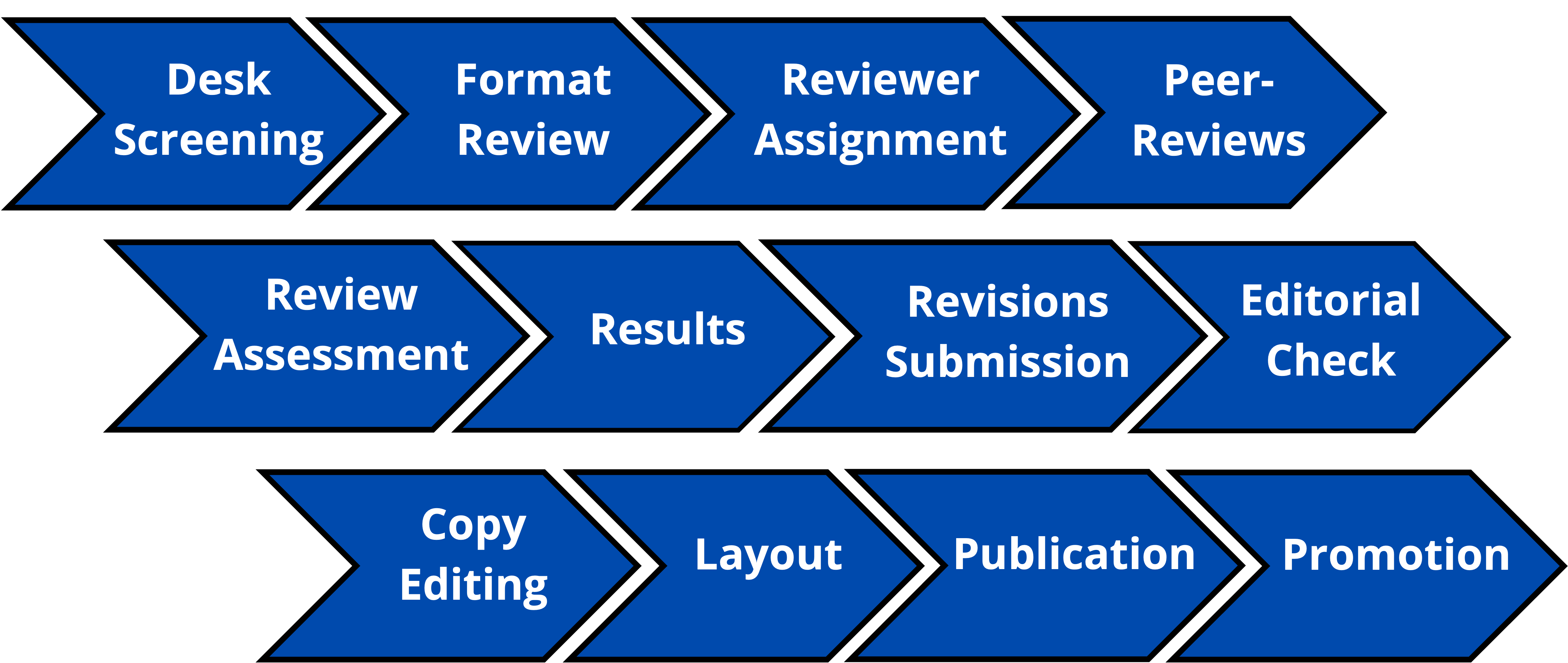
General Guidelines
- Submissions should be no longer than 4,500 words, excluding the title, abstracts, references and appendices. Papers exceeding 4,500 words will not be considered for publication and submissions under 2,500 words are unlikely to be accepted. Please limit appendices to a maximum of three pages.
- Papers should be either research-based or practice-oriented. Submissions must discuss the author's research or a classroom teaching technique. Papers that consist solely of extended literature reviews will not be accepted. Please consult the journal guidelines for these two types of papers.
- All submissions must align with the focus areas of one of the JALT Special Interest Groups (SIGs). Articles falling outside the scope of the SIGs will not be considered for publication.
- All manuscripts are first reviewed by an editor to ensure they comply with the journal's formatting requirements and APA 7th Edition guidelines.
- Papers considered for publication will then be subjected to blind review by at least two readers.
Specific Guidelines
Practice-based Articles
- Practice papers must describe experiences, methods, or innovative techniques that have been implemented in a real-world educational setting. Submissions should clearly explain the teaching context and purpose of the approach, highlighting how it was applied in practice.
- Theoretical proposals or literature-reviewed methodologies will not be accepted. While brief references to relevant literature may help contextualize the practice, articles should focus on classroom application and teacher reflection rather than theoretical discussion.
- These papers must not include data analysis or empirical research. Instead, they should aim to inform and inspire fellow practitioners, offering insights, reflections, and practical takeaways. The emphasis should be on what was done, why it was done, what worked (or didn’t), and what others might learn from the experience.
Research-based Articles
- Research papers may follow any recognized research methodology, including qualitative, quantitative, or mixed-methods approaches, as long as the method is appropriate to the research question and is clearly described. Authors should ensure the methodological choices are well-justified and coherently applied.
- Tables, figures, and graphs must present data clearly, accurately, and concisely, and should only include information directly relevant to the research questions and findings. Avoid presenting data that is not discussed or that does not contribute meaningfully to the study’s goals. Not all data needs to be described in the text—to prevent redundancy, do not repeat information already visible in a table or figure. Instead, the text should highlight and interpret key trends, patterns, or major results that support the argument or analysis.